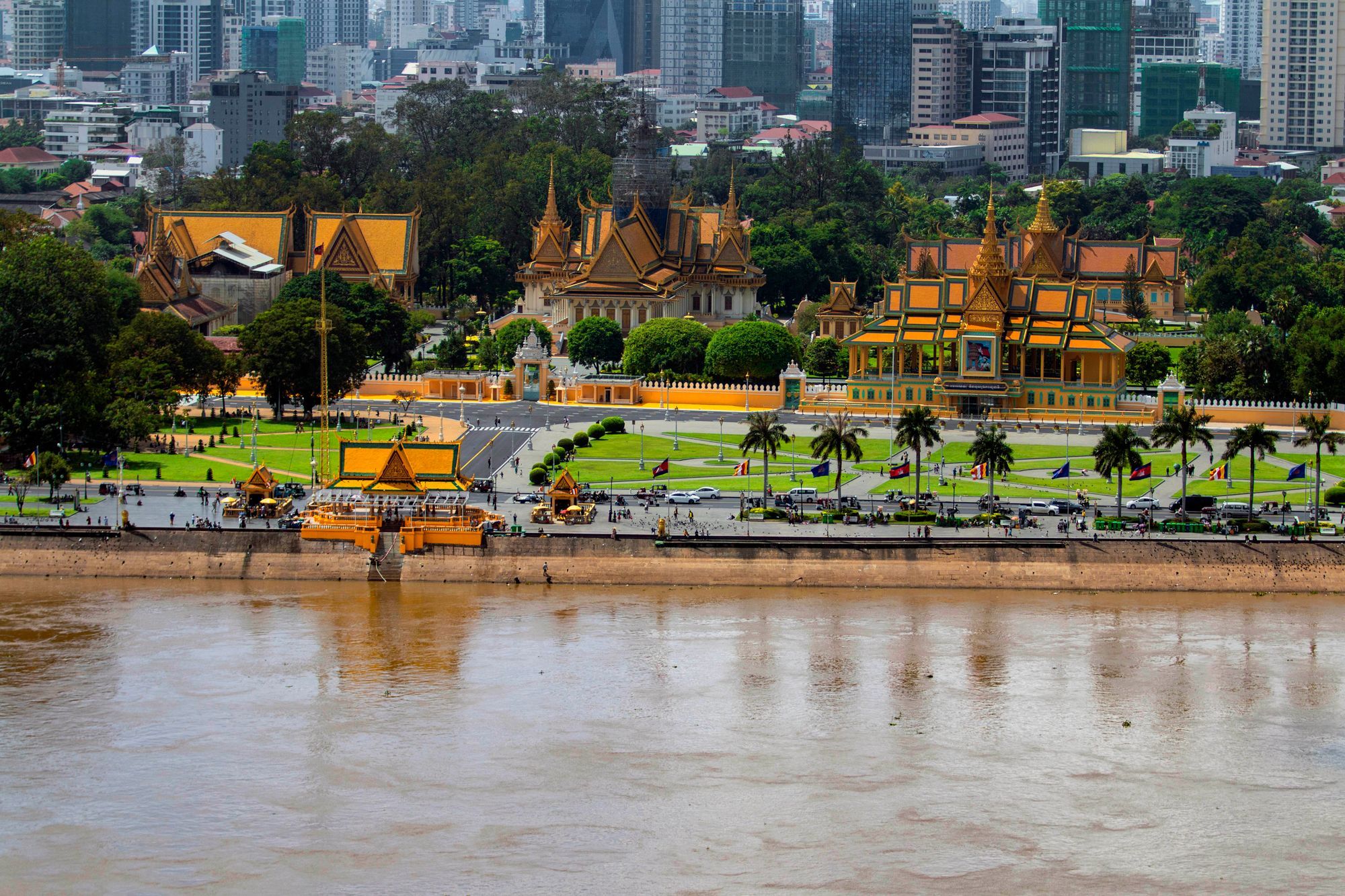
Phnom Penh is Cambodia's capital, set where the Mekong, Bassac and Tonlé Sap rivers meet. Hostels cluster along the riverfront, around the Royal Palace area, in the BKK1 district and near the Russian Market.
Known for
Social, Party, Work-friendly
Hostel areas
Riverside and Royal Palace area, BKK1 (Boeung Keng Kang 1), Russian Market (Tuol Tom Poung), Wat Phnom and Central Market area
You’ll complete your booking with Hostelworld. We may earn a commission from qualifying bookings.
Best areas to stay in Phnom Penh for hostels
01
Riverside and Royal Palace area
Best for: First visits and walking to the main sights
The stretch along the Tonlé Sap riverfront, close to the Royal Palace, the Silver Pagoda and the National Museum, is the most convenient base for a short stay. Bars, restaurants and tour desks line the promenade and the streets behind it. It is lively in the evenings, so expect some noise on the main roads, and the sights are a short walk or tuk-tuk ride away.
02
BKK1 (Boeung Keng Kang 1)
Best for: Cafés, co-working and a calmer base
South of the centre, BKK1 is a residential and expat district with tree-lined streets, coffee shops, restaurants and a number of co-working spaces. It is quieter than the riverfront at night, though you will usually need a tuk-tuk or ride-hail to reach the main sights. It suits travellers staying longer or working remotely.
03
Russian Market (Tuol Tom Poung)
Best for: Markets, food and a local feel
South of the centre, the area around the Russian Market has a dense mix of stalls, street food, cafés and small guesthouses. The market is known for paintings, antiques and crafts, and bargaining is expected. It feels more local than the riverfront and is within a short tuk-tuk ride of both Tuol Sleng and the centre.
04
Wat Phnom and Central Market area
Best for: Budget-minded stays near the centre
North of the Royal Palace, the streets around Wat Phnom and the central markets are busy with traffic, local eateries and shops. The Central Market, a yellow building with four wings, is nearby. Some hostels sit on quieter side streets. It is practical for bus stations and the riverfront but has fewer evening venues than the river.
Live rooms and prices
Compare every hostel in Phnom Penh
See live dorm beds, private rooms, prices and cancellation terms for your dates on Hostelworld.
You’ll complete your booking with Hostelworld. We may earn a commission from qualifying bookings. You’ll choose your dates and guests there.
Staying in Phnom Penh
Phnom Penh sits at the confluence of the Mekong, Bassac and Tonlé Sap rivers, a meeting of waters that shaped both its history and its layout. Cambodia's official tourism site describes a city that has kept much of its French-era character, with wide boulevards, colonial buildings and a lively central area of narrow lanes, markets and shops. It is the country's capital and main transport hub, so most overland routes pass through it.
The Royal Palace and the Silver Pagoda are the best-known sights, built around the site of an earlier citadel. The National Museum, housed in a terracotta building from the early 20th century, holds Khmer art. Wat Phnom, a temple on a small tree-covered hill, is said to have given the city its name. Markets such as the Central Market and the Russian Market (Tuol Tom Poung) are good places to browse crafts, silk and antiques.
Phnom Penh also asks visitors to engage with the Khmer Rouge period. The Tuol Sleng Genocide Museum, a former school turned into the S-21 prison, and the Choeung Ek memorial outside the city are sombre but widely visited, and many travellers set aside part of a day for each. Hostels range from compact dorms near the river to larger social places with rooftop bars, and the city works well as a stop between Siem Reap and the south coast.
Cafés and co-working spaces in districts such as BKK1 and around the Russian Market make it a practical city for working on the road.
Getting to Phnom Penh
Phnom Penh has been moving international flights to the new Techo International Airport (KTI) south of the city, so check which airport your flight uses; the older Phnom Penh International Airport (PNH) is close to the centre. Taxis and ride-hail apps are the usual links into town, and journey times typically depend heavily on traffic. Long-distance buses link Phnom Penh with Siem Reap, Kampot, Sihanoukville and the Vietnamese border, and some routes also run by river boat. Within the city, tuk-tuks and ride-hail apps are the main options.
Best time to visit
Phnom Penh is warm and humid all year, averaging around 27°C. The cool season runs from about November to March and is the most comfortable for sightseeing. The hot season follows from March to May. The rainy season runs from about May to October, with the wettest period typically in September and October and the driest in January and February. Showers are often heavy but short.
Hostel tips for Phnom Penh
Choose between riverside convenience and a calmer district such as BKK1, depending on whether you want evening noise on your doorstep.
Check that dorms have air conditioning and ask how reliable it is, as the hot season from March to May can be intense.
Dress modestly for the Royal Palace and Silver Pagoda, with shoulders and knees covered, and carry something light in your daypack.
Use ride-hail apps or agree a price for tuk-tuks before setting off, and keep phones and bags away from the road side to reduce the risk of snatch theft; the FCDO notes petty crime hotspots in Phnom Penh.
Book onward buses to Siem Reap, Kampot or Sihanoukville through your hostel or an established operator, and check which terminal they depart from.
Phnom Penh hostel FAQs
Where should I stay in Phnom Penh for hostels?
Most backpackers choose the riverside and Royal Palace area for walking access to the main sights and evening bars. BKK1 suits travellers wanting cafés, co-working and quieter streets, while the Russian Market area offers a more local feel with street food and markets nearby. The streets around Wat Phnom are practical for buses and the Central Market. Choose by how much evening noise you can tolerate.
How many days do you need in Phnom Penh?
Many travellers spend two to three days. That is enough for the Royal Palace and Silver Pagoda, the National Museum, one of the central markets, a riverside walk and a half-day visit to the Tuol Sleng Genocide Museum and Choeung Ek. Add a day if you want to explore cafés and neighbourhoods at a slower pace or take a day trip outside the city.
How do I get from Phnom Penh to Siem Reap?
Most travellers take a coach between the two cities, which typically takes around six hours, depending on traffic and stops. Several operators run daytime and night services, and hostels can usually book them. Flights are a quicker alternative on some routes. Check which airports your flight uses, because Phnom Penh's international flights have been moving to Techo International Airport.
Which airport do I fly into for Phnom Penh?
Phnom Penh has two airports in the picture. The older Phnom Penh International Airport (PNH) is near the centre, while the new Techo International Airport (KTI) lies south of the city and has been taking over international services. Your airline or booking confirmation will state which one you land at. Allow extra time for the transfer into town and confirm your arrival airport before arranging a pickup.
What is the weather like in Phnom Penh?
Phnom Penh is warm and humid throughout the year, averaging around 27°C. The cool season, roughly November to March, is the most pleasant. The hot season runs from about March to May. The rainy season, around May to October, brings heavy showers, with September and October typically the wettest and January and February the driest.